
- CHELSEA 19-20 KITS - EMPTY SPACES THE BLOG Olahraga pinimg.com Empty Spaces on Twitter: 'New #PSG Nike Hm/Aw/Th 2015-2016. Twimg.com Manchester City Pes Kit weebly.com.
- Jun 13, 2015 - Explore Etons Of Bath's board 'Thai House', followed by 241 people on Pinterest. See more ideas about thai house, design, asian interior.
Get the latest Besiktas news, scores, stats, standings, rumors, and more from ESPN.
Most of the times, being the third biggest club in your city is not a great source of joy and pride, but Beşiktaş (pronounced “beshiktash”) are one of the few exceptions to this universal unwritten rule. They may have less titles, a smaller stadium and a smaller fan base than their two huge city rivals, Galatasaray and Fenerbahçe, but no matter what, they are a true football megapower in Turkey, having earned respect at international level as well.
Basic facts

Founded: 1903
Country: Turkey
City: Istanbul

Home grounds
BJK İnönü Stadium (1947–2013)
Ataturk Olympic Stadium (2013–2016)
Başakşehir Fatih Terim Stadium (2013–2016)
Vodafone Park (2016–)
Main trophies
Turkish Süper Lig: 15 (12)
Turkish Cup: 9
Prominent players
Rıza Çalımbay, Hakkı Yeten, Mehmet Özdilek, Şeref Görkey, Ulvi Güveneroğlu, Kadir Akbulut, Metin Tekin, Gökhan Keskin, Samet Aybaba, İbrahim Üzülmez, Feyyaz Uçar, Ahmet Özacar, Sanlı Sarıalioğlu, Ali Gültiken, Ertuğrul Sağlam, Şenol Birol, Sergen Yalçın, Bobô, Ricardo Quaresma, Demba Ba, Nihat Kahveci, Mario Gómez, Hugo Almeida, Guti Hernández
Club records
Most games played: Rıza Çalımbay (602)
Top goalscorer: Hakkı Yeten (382)
The Istanbul Football League 1923–1924 champions.
History
Beşiktaş Jimnastik Kulübü (Gymnastics Club; so it is in fact incorrect to refer to this club as Besiktas FC in English), were founded in 1903 in the homonymous neighbourhood of Istanbul's European part, which makes them the oldest of the city's “Big Three”.

In the early history of the club, the football team of the club were playing in Istanbul Football League and in which they alongside Galatasaray and Fenerbahçe were outstanding. Beşiktaş JK won 13 titles during the period in which the league existed. They spent more than 50 years competing in Istanbul's local league, until 1959, when Turkey got its first national top flight. Or not exactly so, at least according to Beşiktaş …
Dispute about titles
At the Kara Kartallar, “Black Eagles”, they claim to have won the champion's title in 1957 and 1958 as well. Those two seasons, the “Turkish Federation Cup” was organized in the country, and both years it was Beşiktaş indeed who won the title. In 2002, the Federation put a final end to the “dispute” regarding how many Championship titles Beşiktaş really have, choosing the… middle solution, so as to keep everyone happy. The “Federation Cup” was not acknowledged officially as the predecessor of the Turkish national Championship, but, they did accept those two titles as valid in the country's star system, according to which every club can add a golden star to their emblem for every five Championship titles won. The ruling of the Federation was half a victory for Beşiktaş, but a victory nonetheless.
Excluding the seventies, during which Beşiktaş had a very “quiet”, titles-wise, decade, the club have been lifting trophies on a regular basis. Their “top highlight” period was between 1989 and 1995 when they won either the Championship or the Cup (in 1990s case both) every season (excluding 1992–93). Their triumph in the Turkish top flight in the 1991-92 season was the most impressive of all, since, for the first time in the country's history, a club won the Championship title finishing the season unbeaten.
At international level, Beşiktaş reached the quarterfinals of the European Cup (today's Champions League) in 1987, but this success of theirs was not really as big as it seems, since they only beat one opponent in that edition of the competition, and won just two matches, against Albanian side Dinamo Tirana, in the first round. For reasons that had nothing to do with football, Cypriot side APOEL did not play against the Turks in the second round, with Beşiktaş qualifying without shedding a drop of sweat. In the quarterfinals, still Soviet (before Ukraine's independence) Dynamo Kyiv beat Istanbul's Black and Whites by a total score of 7-0 in the two games between them.
UEFA competition success
The biggest real success of Beşiktaş in a UEFA competition came in 2002-03, when they reached the quarterfinals of the UEFA Cup (today's Europa League). After eliminating Sarajevo, Deportivo Alavés, Dynamo Kyiv and Slavia Prague, the Turkish side met Lazio in the last-8, losing both games, and having their dream to progress further in the competition terminated.
Player records
In the club's history of over 110 years, the player who has had the honour and privilege to wear their jersey more times than anyone else is Rıza Çalımbay, a winger just 1.65 tall, who spent his entire career at Beşiktaş, from 1980 to 1996. Hakkı Yeten, a striker practically unknown outside of Turkey, netted an incredible 382 goals in 439 matches between 1931 and 1948, in times when football was incredibly different to today's. Feyyaz Uçar, another formidable striker of a much more modern era, scored 184 goals for Beşiktaş between 1982 and 1994, being a key figure in the team that won three successive Championship titles from 1990 to 1992.
One of the entrances of the old BJK İnönü Stadium.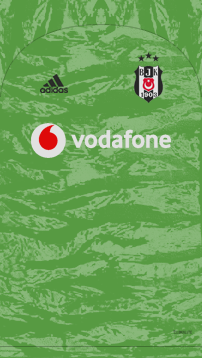
New stadium
Beşiktaş happily entered their brand new stadium in 2016, a major upgrade to their old BJK İnönü Stadium. The Vodafone Arena is situated exactly at the same place, less than 300 meters from the famous Dolmabahçe Palace on the European side of Istanbul. The old stadium was named after Turkey's second president İsmet İnönü, an avid Beşiktaş fan. His name was given to the stadium in 1973, soon after his death.
Beşiktaş celebrated their first months in the new stadium winning the Championship title, their first since 2009, signaling the start of a new glorious era for the club.
The team in 2011.By Dimitris Basias
Logo
BJK are the initials of the club, 1903 is the founding year, and a small version of the Turkish flag is situated at the heart of the emblem. According to the star system of the Turkish Football Federation, Beşiktaş can have two golden stars on their logo, corresponding to their 12+2 Championship titles won. The club have chosen to have those two stars in black on their jerseys, so as to be in harmony with their predominantly black and white crest.
Beşiktaş JK timeline
1903 The club is established.
1924 First time Istanbul Football League winners.
1934 First time winner of the Turkish Football Championship.
1943 The club become the first to win Istanbul League five times in a row (1939-1943).
1944 First time winner of the Prime Minister's Cup.
1947 The club play their first match at the BJK İnönü Stadium.
1957 First time national league champions.
1975 First Turkish Cup title.
2016 The club move to the Vodafone Park.
Trivia
Football clubs also founded in 1903
Athletic Bilbao
Atlético Madrid
Boavista FC
Grêmio

›Football clubs ordered after establishment
External links
›Official website
›Beşiktaş on Wikipedia
References:
https://en.wikipedia.org/wiki/Beşiktaş_J.K.
https://tr.wikipedia.org/wiki/Beşiktaş_JK
https://en.wikipedia.org/wiki/Istanbul_Football_League
https://tr.wikipedia.org/wiki/Rıza_Çalımbay
https://tr.wikipedia.org/wiki/Hakkı_Yeten
https://tr.wikipedia.org/wiki/Feyyaz_Uçar
https://en.wikipedia.org/wiki/İsmet_İnönü
http://www.bjk.com.tr/en/cms/tarihce/2/73
Image source:
1. Tuğrul Yenidoğan
2. Dimitris Basias
3. Biso
Sabanci Museum Istanbul
With its prominent position looking out across the Bosphorus, the Sakip Sabanci Museum Istanbul may be a little out of the way from the usual tourist attractions, but both its permanent collection and temporary exhibitions make it well worth the journey. It also offers the chance to venture away from the crowds and see Emirgan, one of the most affluent neighborhoods of the city.
Main entrance of Sakip Sabanci Museum, Istanbul
Also known as the 'Horse Mansion'
Its full title is the Sabancı University Sakıp Sabancı Museum and it is set in a 1920s mansion known as Atlı Köşk', (Horse Mansion – named after a statue in its grounds) that was previously used as the summer house for the Hidiv family of Egypt , and as the Montenegrin Embassy. It was bought by the Sabanci family in 1951, and opened as a museum in 2002.
Painting collection at Sakip Sabanci Museum, Istanbul
What is there to see at the Sakip Sabanci Museum?
The permanent collection is made up of the Calligraphy Collection, the Painting Collection, and the Collection of Furniture and Decorative Arts, and contains some magnificent examples of Islamic and Ottoman traditional arts and documents, dating back as far as the 14th century.
The Sakip Sabanci museum exhibition space also hosts temporary exhibitions by big name artists including the Monet Sakip Sabanci Museum exhibition in 2012, the Rembrandt Sakip Sabanci Museum exhibition also in 2012, and the Sakip Sabanci Museum Anish Kapoor exhibition in 2013. One of the works by Anish Kapoor, Double, has now joined the museum’s permanent collection, on display in the lush gardens.
If you’re interested in Turkish history and modern art Istanbul has lots more to offer, at other musuems including the Pera Museum, the Istanbul Modern, and the Rahmi M. Koc Museum.
What else is there at the Sakip Sabanci Museum?
The museum is also home to MSA’nın Restoranı or MSA's Restaurant (MSA: The Culinary Arts Academy of Istanbul). This experimental restaurant is run by the instructor and recent graduate chefs of MSA - where the students complete their first internship in a real restaurant environment. In other words, the instructor chefs are teamed with their students - the brilliant chefs of the future!
Empty Spaces Song
MSA restaurant focuses on Anatolian traditions and recipes meanwhile embracing and combining it to the world cuisine - staying as authentic as possible.
The adjoining venue, The Seed, hosts classical concerts, along with conferences and talks.
MSA Restaurant of Sakip Sabanci Museum
When is the Sakip Sabanci Museum open?
The Sabanci Museum hours are from Tuesday-Sunday from 12:00 pm - 8:00 pm (and until 8pm on Wednesdays). The Sabanci Museum price is normally 40 Turkish Lira for entry, but free on Wednesdays.
Empty Spaces Lyrics
The Sabanci museum hours are from Tuesday-Sunday from 10am-6pm
Empty Spaces Linkin Park
How can I get to the Sakip Sabanci Museum?
Take a bus to Emirgan from Taksim (40, 40T or 42T) or Kabataş (22, 22RE or 25E). Alternatively board the Hop On Hop Off Classıc Bosphorus tour from Dentur Avrasya from Kabataş or Beşiktaş. Combine a visit with a walk around the beautiful Emirgan Park and a lazy brunch at MSA's Restaurant overlooking the Bosphorus.
Empty Spaces Pink Floyd
Have you checked Rahmi Koç Museum?